Pages

Sunday, January 17, 2016

Some photos

Here are some photos from my holiday in Nova Scotia to keep this blog going.


Wednesday, December 30, 2015

I've realized that many of my pictures are vanishing and being replaced with a triangle. We've contacted Google and they said they will look into it. If nothing happens I will replace these photos when I get back to St John's.
Happy New Year!

Sunday, November 15, 2015

Northern Shoveler

Today I went to Bally Haily golf course to look for a Common Moorhen which hasn't been seen in a few days. No luck, but I did enjoy nice views of a female Northern Shoveler. Without it's odd bill a female Northern Shoveler looks like any old pond duck. The bill of the Shoveler is a massive long and wide object - perfect for scooping for through cattails looking for goodies. The shoveler eats small invertebrates and seeds. A photo is below. 


Sunday, November 1, 2015

Divers

Diving ducks are one of Newfoundland's many bird specialities. In a day you can see over 50 Greater scaups, 30 Tufted ducks and the odd Lesser scaup. Today I witnessed that. I went over to Kenny's Pond to have a second go at the Ruddy duck which seems to have just stayed for a day. The amount of divers for this time of year was staggering - at least 90 individuals mostly Tufted ducks. 

Greater Scaup

Tufted duck

Monday, October 26, 2015

Kent's Pond

If a human looked like a shoveler is childhood life would be filled with taunting and bullying. Northern Shovelers are a queer looking bird with a large bill that looks like a shovel. I went looking for this oddity on Sunday and had no luck. Northern Shovelers are an annual occurrence in Newfoundland but I really wanted to get a good picture of the bird. Another odd bird is the coot. It's easy to see where the saying "Crazy as a Coot" comes from by just looking at this bird. It has huge webbed feet for it's small chicken like body. I saw two Coots swimming around in the water. Pictures of the Coots and two American Wigeons are below. 
The American Coot

A Female American Wigeon at Kent's Pond
Wigeon doing a head shake

Tuesday, May 26, 2015

Little Egrets

This spring has not been overly exiting with Eurasian rarities as last year's was. This was fine, though- I was in Point Pelee enjoying some of the coolest birds ever. But, as this is Newfoundland, rare birds are always coming in. Some even as rare as the Little Egret - one of the most challenging identifications in all North America. Little egrets look almost identical to the Snowy egret. Usually, what makes this easy is that Little Egrets live in Europe and the Snowy lives on the other side of the pond. But when one of these birds show up in Newfoundland it's "get out the scope time and lets look for plumes" - the simplest way to distinguish these birds. Some pictures of this awesome bird as well as other birds that I have seen in St John's, Point Pelee, and Nova Scotia are below.
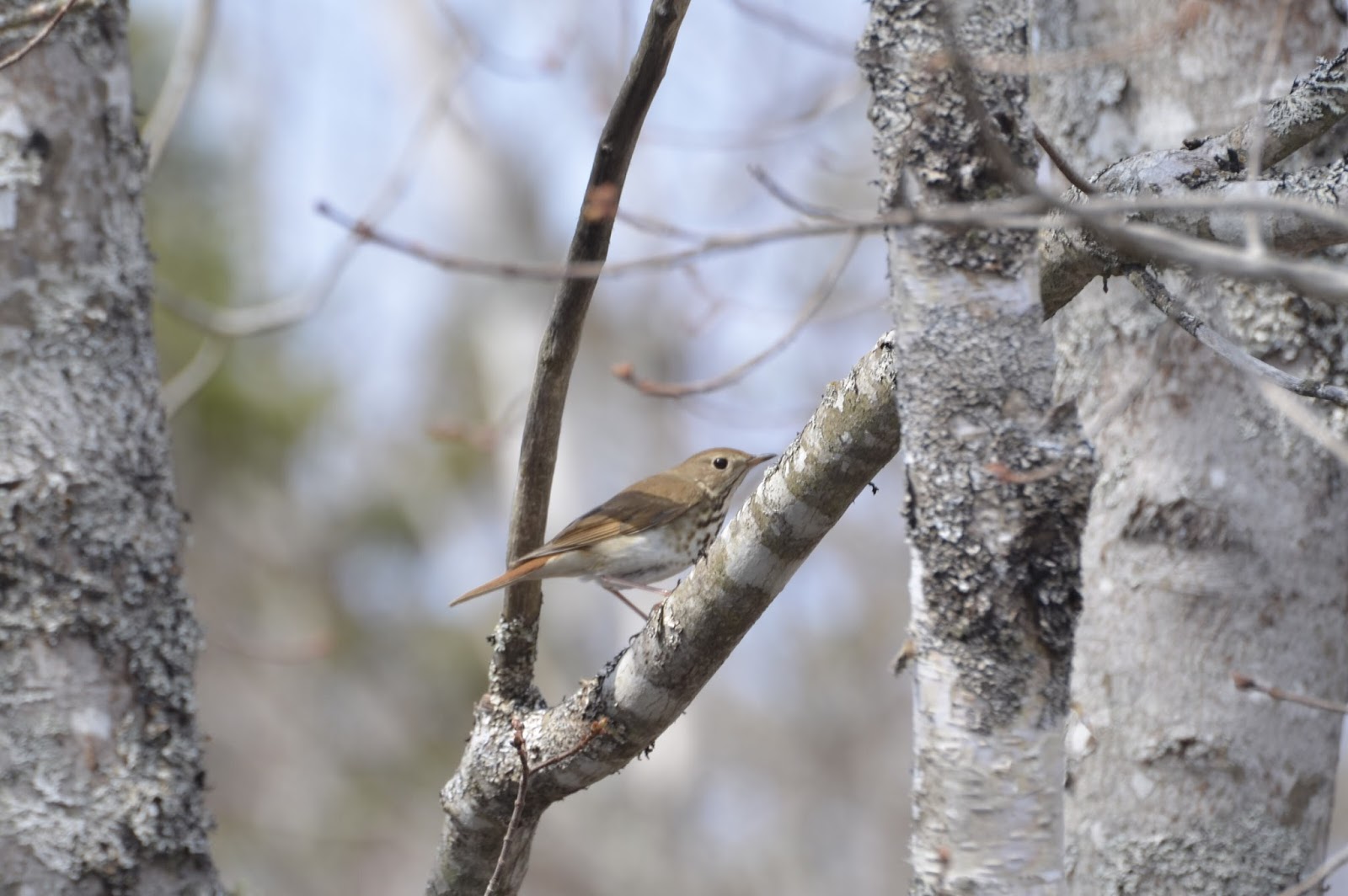
Wood Thrush
Canada Goose

Mourning Dove
Black and White Warbler
Palm Warbler

Whip or will


Sunday, April 26, 2015

Bully of the Seas at Bay

Yesterday evening a report came in saying that there was a Pomarine Jaeger at the Elks Club just a 10 minute walk from my house. When I got to the Elks Club there was no sign of a large sea bird with a powerful bill. Just a limp wet dirty bird on the ground dead as a doornail. There it was - the bully of the seas. The carcass was in good condition, so I dropped it of at Ian Jones's (who is a ornithology prof here at MUN) house. A photo of the bird is below.


Sunday, April 19, 2015

Tufted ducks

Every where else in North America you expect to see Mallards and Black ducks at your local duck ponds, but in Newfoundland things are a bit different. When you go to local ponds you can expect to see some very neat and in everywhere else in the country rare birds. Birds such as Northern pintails, Lesser black-backed gulls, Tufted ducks, Eurasian wigeons and Iceland gulls. Tufted ducks are a major attraction for eco tourists to St John's. Tufted ducks or Tufties are a lot like a scaup - small, they have black on them and they usually flock together. At places like Quidi Vidi lake, Burtons pond and Long pond finding Tufted ducks is usually a simple task.


A Tufted Duck.


A common gull of the atlantic - The Herring gull


A stylish Tufted duck


A Borea chickadee

A Northern Pintail
A Dark-eyed junco


American wigeon the cousin of the Eurasian wigeon

A American wigeon

Saturday, April 18, 2015

Photos

This is a posting to keep this blog going. Some pictures from this week are below.
                                         A Ring-billed gull at Burtons Pond
                                          A Northern Pintail
                                          A Ring-billed gull. A sign of spring.
                                          Spring Crocuses


Sunday, March 15, 2015

Cold Cape Spear

I haven't been birding a lot lately because birding has seemed to slow down. Their are not many rare birds around and its pretty cold around here.  Never the less on Saturday I went out to Cape Spear to look for some birds. Their was loads of wind and it was blowing so hard it almost knocked over my scope. Their is usually quite a bit if bird action here in the woods on the way up to the cape but today it looked dead. No drumming of woodpeckers on the trees, no song of chickadees and no finches. At the cape though it was pretty good. Two bald eagles were soaring around, many long tailed ducks, a few eiders and some purple sandpipers. Their was 3 King eiders as well. I went down a slippery slope and wiped out. Ouch!

Tuesday, February 17, 2015

A Thrasher on a cold day

A Brown Thrasher is a bird that does not want to be seen. You may wonder how such a streaked and large bird can stay hidden in the shrubbery so well. They make little movement and are quick to flee. Brown Thrashers have quite a singing repertoire and can sing over 1000 bird calls. They can imitate many bird calls, cars and cats. A Brown Thrasher should be in the southern parts of the USA at this time of year. This year a Thrasher made a appearance at Long Pond. I went over to see it on Sunday. Brown Thrashers are a robin sized bird but with a larger tail with hooked looking bill. They are omnivores and feed on whatever they can find in their area - newts, corn, fruit, insects, seeds, grains, eggs, chicks and so forth. The thrasher at Long Pond was quite easy to locate, but he did bolt whenever someone wanted to get a picture of him.
                                                           A thrasher ebird map

Monday, February 2, 2015

Grackles in Newfoundland

In the more southern portion of this continent Grackles are birders biggest enemies. Seed guzzlers and egg killers Common Grackles are feisty birds. In Newfoundland Grackles are quite uncommon. In St John's we have around two flocks of Grackles overwintering. Today I found a flock in Lions Club Park. For those who haven't seen a Grackle. Grackles look like a crow but much smaller and with a shiny, purplish head. In the in other parts of North America Grackles are considered vermin by birders, biologist and feeder watchers. The Grackles range extends over much of North America from Nova Scotia in the east to Alberta in the west. They travel in large flocks and feed on seeds, garbage, insects, fruit and basically anything they can get their beaks on.

These Grackles are feasting on suet!

Saturday, January 10, 2015

A Southern Warbler in a park

  In the winter Pine Warblers are one of the drabbest looking warblers around. In Newfoundland Pine Warblers are usually seen in the fall, not in January. Pine Warblers are a southern warbler. They eat insects such as larvae and caterpillars. This year a Pine Warbler showed up in Bowering Park, St John's. I went to see this Pine Warbler today. The weather was horrible. It was rainy and then the rain turned into a slushy snow fall. The winds were also horrible, but the Pine Warbler was seen. Considering the Pine Warbler should be in the southern US right now and the temperature here is dropping into the -20s C with the wind chill, the Pine Warbler is probably facing its last few days alive. The Warbler is now living on seeds. That is not a sufficient feed to keep it alive. It really needs lard 24/7 if it is to survive. Bird watchers have put out a suet cake for it. If seen please report to nf.birds!

This weather is bad news for the Pine Warbler
The Pine Warblers range.

Sunday, January 4, 2015

Gull Identifacation

Gull identification is one of the hardest aspects of bird watching. There are different winter plumages, hybrids and different plumages for the age of the gull. You could send off the American Bird Alert by thinking a Lesser black backed gull-Herring gull hybrid is a Yellow-legged gull or a Lesser black backed gull is a Slaty black backed gull. Telling by size can be useful but only if the birds are in close range and are standing right next to each other. If you have found an odd looking gull take out your field guide and look at three identification points of the bird - back colour, head pattern and wing pattern.
Back colour:
The back colour is a easy way to distinguished species like Great black backs from Glaucous gulls. It also helps when your looking at a large flock of gulls. Even the smallest change of the shade of grey can mean a different species of gull.
Head pattern:
During the breeding season most species of gull have a white head with the exception of black headed species such as Bonapartes and Laughing. In the winter most of these white heads turn streaky except for some species such as Great black backs and Western gulls. The black headed species get a black blotch on their heads.
Wing pattern:
Most gull species have black wingtips but some species like Iceland gulls and Glaucous gulls have pale wingtips.
Happy New Year!

Saturday, December 27, 2014

Finding Seaducks

   Sea ducks are one of winter's highlights for many birdwatchers. While being on vacation in Nova Scotia I made a trip down to a small bay. The results were incredible. The most common bird seen was the Red-breasted merganser. Over 100 of them were seen. Hooded mergansers were very numerous too. I found a small flock of about 25 birds. 3 Buffleheads were seen. One of many favorite type of birds are grebes. I saw 3 Horned grebes and 1 Red-necked grebe. In Newfoundland these types of grebes are infrequent and rare. My scope helped me find many smaller types of birds such as Buffleheads and a flock of Common goldeneyes that were a long way of shore. The weather had a negative effect on finding the birds because it was very foggy.


Sunday, December 14, 2014

A little warbler a long way from home!

The yellow throated warbler should not be anywhere north of Tennessee in the winter. Where does one show up? - Kelly's Brook, St John's - a small brook next to a large park. Yellow throated warblers are very glamorous with a striped body and a bright gaudy yellow throat. I found the bird on Saturday the 13th of December. When we got there, there were quite a number of birders looking for the warbler. One group of birders had been there for 2 hours. We looked around with no luck. Then we found a large flock of juncos. We followed the birds across the river until we had found the flock again. Then I saw a small bird with a large beak. I whispered, "I got the bird." I showed the bird to my companion in the art and another birder who was there too. What a good day! Below is an ebird interactive  range map. You can see a a bit of blue over St John's.

Monday, November 10, 2014

Deciding on a Scope Tripod

After buying myself a scope I was faced with a problem. What tripod and head should I purchase to go along with the scope? After looking on our friend google I found out that there are thousands of different tripod models out there - Nikon, Manfrotto and  Swarovski are just a few of the many companies that produce tripods. Another problem arose - what style head do I want? I ventured down to the local birding shop with my friend Bobbie to find that they had some nice tripods but they were either to hard to control or they were too light to survive the Cape Spear winds. We went to a camera store to see loads of tripods but all of theirs were meant for cameras. We went back to man's best friend - google - to see videos about choosing tripods. We settled on the Vanguard Abeo 283AV which is light and durable. Another bonus is free shipping from Amazon.ca.

Saturday, September 27, 2014

E-BIRD

I've been finally convinced to join E-BIRD. After checking out their website I came to the conclusion  that this is a very interesting program. What I really like about it is that you can check out all the data that has been accumulated over many years. I learned that an Ivory-billed Woodpecker was reported in Oregon; whoever let that one pass must be pretty gullible! But, some things were a bit more believable. The invasive Eurasian-collard Dove can now be seen in British Columbia, Alberta and Saskatchewan. If you look at data from 2006 and then 2014 you can see that they've been expanding on a northwestern pattern. The next Starling? These birds may be in Newfoundland soon. The recently discovered Omani Owl was known as E-bird's missing species due to the fact that after the discovery of the owl in the summer of 2014 no e-birder has found one yet. Then people started to submit data of rare and endangered species. With this information, and thanks to this, 93 new species were added to E-bird including the Omani Owl. The things you can learn about nomadic species is very cool. I looked at last year's data on the Snowy Owl and Newfoundland just looks like a blob of purple. As you can see then, I am ready to launch my first e-bird entry from the time I went to Mundy Pond.  

Saturday, September 6, 2014

Acorn Woodpecker Video

I was looking at the Cornell Lab of Ornithology's website and I came across a fascinating video about Acorn Woodpeckers. The video was made by Marie Read and it is very well done. The footage and pictures are amazing. The video explains their foraging habits and how they store acorns in tree holes.  If you haven't heard or seen an Acorn Woodpecker it will be a surprise to see what they look like. They look a lot like little clowns. They have a blueish black back and black on the nape and a red crown. The bird has a bit of tan on the front of the head and around the bill there is black. Acorn Woodpeckers are common in there fairly limited range. There range goes from Southern Central America to to Northern Oregon and Southern Washington State. They live in social groups of up to a dozen or more birds. Take a look:
www.allaboutbirds.org/guide/acorn_woodpecker/


Friday, August 29, 2014

Small Park Lots of Birds

I went to a park that was recommended by a bird watcher I met a few days ago. The park was located just up the road from my grandma's house in Saskatoon.  She said that birds you would see were Blue-headed vireos and Wilson's warblers. When I arrived at this park one first look and I thought for sure that this lady had pulled a fast one and sent me to the worst place in the whole of Saskatchewan to bird watch.  I was wrong! Right when I was about to leave to go home, I heard the call of a Wilson's warbler. I found the Wilson's and then I started to scan for movement. There was a flash of grey and blue - it was a pigeon. After locating the commoners of the bird world I started looking for a Blue-headed vireo. After a half an hour of seeing the same Eastern kingbird I started to lose enthusiasm. Finally I gave up, I started to trudge out of the park in my wet and cold feet (I was wearing sandals). A dog walker came in and her dog started yapping at something. Then a little bird flew out of a Chokecherry bush to a crabapple tree. Thinking it was a Warbler or a finch I checked it out. It was a Blue-headed vireo! So, a humble, small park can mean lots of birds. The complete list is as follows:
Black-capped chickadee
Palm warbler
Yellow warbler
Grey catbird
Wilson's warbler
Eastern kingbird
Blue jay
Rock dove
Black-billed magpie
House sparrow
Blue-headed vireo